August 8, 2026
How to Automate Treasury Operations Across Multiple Banks
How to Automate Treasury Operations Across Multiple Banks
Managing treasury operations becomes increasingly complex as companies work with multiple banks, financial instruments, ERP systems, and approval processes. Treasury teams may need to manage Letters of Credit, Bank Guarantees, Loans, Credit Facilities, and Payments while keeping financial data synchronized with the company's ERP.
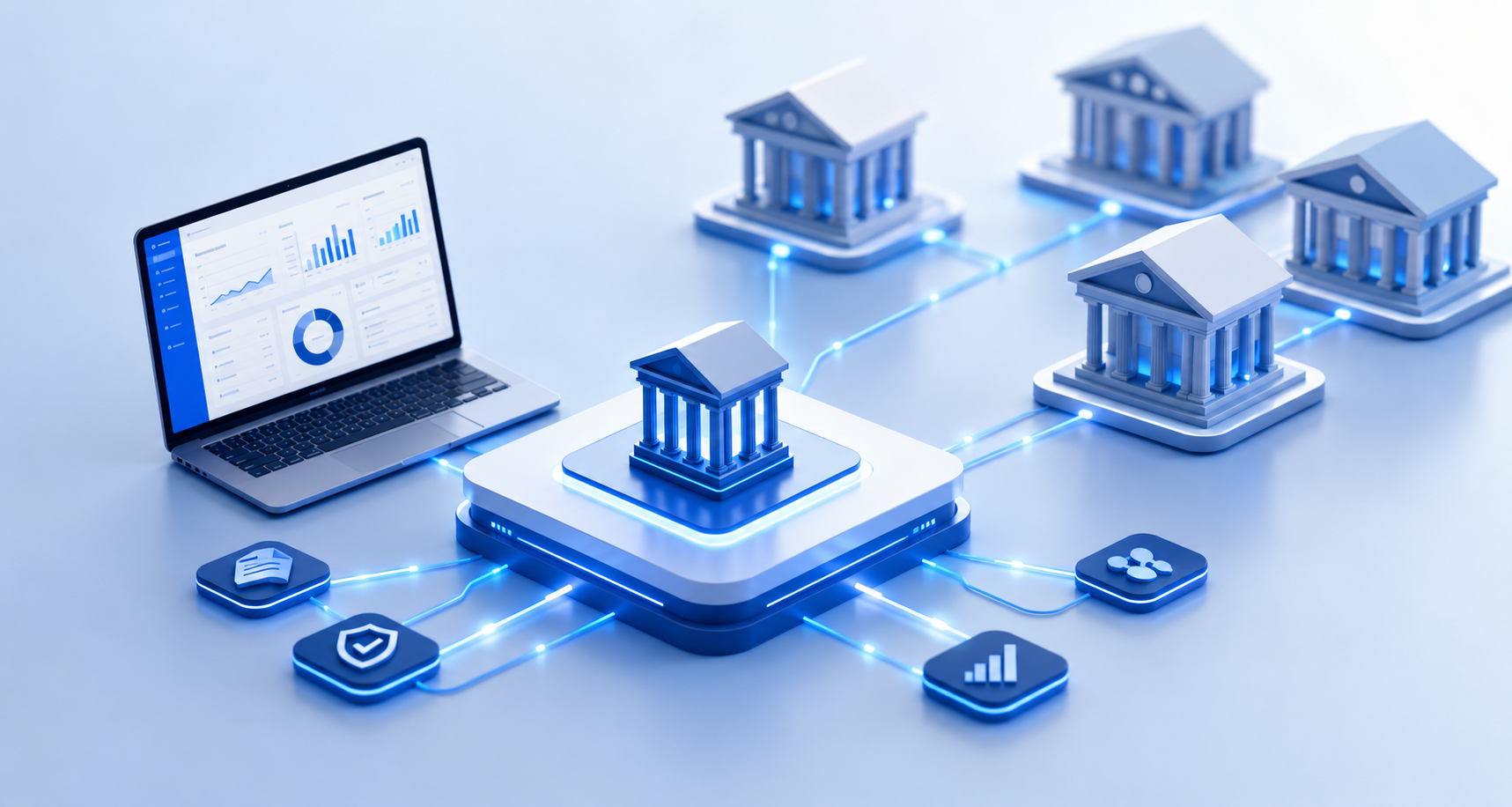
Treasury automation addresses this complexity by connecting banking relationships and financial workflows through a centralized platform. Instead of moving information between bank portals, spreadsheets, emails, and ERP systems manually, companies can connect their ERP with their banking partners and manage key treasury processes through a single workflow.
For organizations operating across multiple banks, automation can improve visibility, reduce manual work, strengthen approval controls, and create a more consistent record of every banking transaction.
What Is Treasury Automation?
Treasury automation is the use of technology to automate and connect financial processes such as banking transactions, payment workflows, Letters of Credit, Bank Guarantees, Loans, facility management, reconciliation, approvals, and reporting.
A modern treasury automation platform typically connects three parts of the financial environment:
ERP system → Treasury platform → Banking partners
The ERP provides financial and transactional information. The treasury platform manages workflows, approvals, instruments, and banking processes. Banking connectivity allows information and instructions to move between the company and its financial institutions.
The objective is not simply to replace spreadsheets. It is to create a connected process where information can move between the ERP, treasury team, and banks without unnecessary manual intervention.
For companies working with several banking relationships, this can provide a single operational view of treasury activity while allowing each bank to remain connected through the appropriate banking channel.
Why Is Multi-Bank Treasury Management Difficult?
Working with multiple banks can create operational complexity even when individual banking processes are relatively straightforward.
A treasury team may have to access several bank portals, maintain spreadsheets, exchange emails with banking teams, track approvals, monitor facility limits, and reconcile banking activity back to the ERP.
This can create several challenges.
Multiple bank portals
Each bank may have its own portal, workflow, interface, and reporting format. Treasury employees can spend significant time moving between systems simply to monitor banking activity.
Manual data entry
When information is transferred manually between an ERP, spreadsheets, emails, and banking platforms, the same information may need to be entered more than once.
This increases administrative work and creates opportunities for errors.
Limited visibility across facilities
When credit facilities are managed across multiple banks, it can be difficult to maintain a consolidated view of utilization, sublimits, and available headroom.
Without centralized visibility, treasury teams may need to collect information from several sources before making decisions.
Email-based approvals
Banking instruments often involve multiple stakeholders. If requests, approvals, amendments, and confirmations are managed through email, it can become difficult to maintain a consistent record of the process.
Manual reconciliation
Banking activity must ultimately be reflected in the company's financial records. When reconciliation depends heavily on manual processes, month-end activities can become more time-consuming.
Audit preparation
Treasury teams need to know what happened, who approved an action, and when it happened. Scattered records across emails, spreadsheets, and different banking platforms can make this harder to demonstrate.
Treasury automation brings these activities into a more connected environment.
What Treasury Processes Can Be Automated?
The specific processes that can be automated depend on the company's treasury requirements and banking infrastructure. However, modern treasury platforms can connect several important areas of corporate banking.
Letters of Credit
Letters of Credit can involve multiple steps, from the initial request through issuance, amendments, confirmation, and ongoing tracking.
An integrated workflow can reduce the need to manually transfer purchase order and instrument information between systems.
Bankors, for example, connects Letters of Credit with ERP data and banking infrastructure. Its platform can pull purchase order data from Oracle Fusion and connect with issuing banks through SWIFT MT700 and MT707.
Letters of Guarantee
Bank Guarantees can also require requests, approvals, bank communication, amendments, renewals, and ongoing monitoring.
Automating these workflows can help treasury teams maintain centralized records and reduce dependence on email-based processes.
Loans
Loan-related information can be managed as part of a broader treasury environment, giving finance teams a more consistent view of borrowing and related banking activity.
Bank Facilities
Facility management is particularly important for organizations that maintain relationships with multiple banks.
Automation can provide visibility into facility utilization, sublimits, and available headroom across banking relationships.
Bankors provides real-time visibility into facility utilization and sublimits across Letters of Credit, Letters of Guarantee, and Loans, along with headroom alerts.
Payments
Payment workflows can also be connected to banking infrastructure, allowing organizations to manage payment processes through established banking connectivity methods rather than relying on separate manual processes for each institution.
How Does ERP-to-Bank Connectivity Work?
ERP-to-bank connectivity connects financial information and workflows between a company's ERP system and its banking partners.
A simplified model looks like this:
ERP → Treasury Platform → Bank Connectivity → Bank
The ERP remains the source of financial and business information, while the treasury platform manages the banking workflow and connects to the appropriate financial institution.
Different banks may support different connectivity methods. Common approaches include:
- SWIFT
- Host-to-host connections
- Bank APIs
- ISO 20022
- REST APIs and webhooks
The appropriate connection depends on the bank, transaction requirements, existing infrastructure, and the organization's technology environment.
Bankors currently supports SWIFT MT and MX, host-to-host connections, bank APIs, and ISO 20022. Its listed ERP and finance integrations include Oracle Fusion, SAP S/4HANA, Workday, and Microsoft Dynamics, with REST APIs and webhooks also available.
The important principle is that treasury teams should not have to manually move the same information between their ERP and banking systems whenever a transaction requires action.
How Can Treasury Automation Improve Multi-Bank Visibility?
One of the biggest benefits of treasury automation is the ability to bring information from multiple banking relationships into one operational view.
Consider a company with several credit facilities across different banks.
Without centralized visibility, treasury teams may need to review individual bank systems and spreadsheets to determine:
- How much of each facility has been used
- How much capacity remains
- Which sublimits are approaching their thresholds
- Which Letters of Credit or Guarantees affect available capacity
- What exposure exists across the banking group
A connected treasury platform can consolidate this information and make it available through a single environment.
Bankors is designed to provide real-time visibility into facility utilization, sublimits, and headroom across banking relationships.
For CFOs and finance leaders, this can turn treasury information into something that is available for decision-making without waiting for manual consolidation.
How Can Companies Automate Letters of Credit and Bank Guarantees?
Letters of Credit and Bank Guarantees are good examples of treasury processes where workflow automation can make a measurable operational difference.
A typical automated process can follow a structure such as:
Request → Approval → Bank submission → Confirmation → Amendment or renewal → Record keeping
The exact workflow varies depending on the company's policies and the bank involved.
With an integrated approach, information can originate from the ERP or another financial system, move through the required approval process, reach the relevant bank through its supported connectivity channel, and return confirmations or updates to the company's financial environment.
This reduces the need to repeatedly re-enter information or manage every stage through separate email conversations.
Bankors reports an average reduction in Letter of Credit issuance time from 12 days to 18 hours across its pilot customers.
What Should Companies Look For in Treasury Automation Software?
Choosing treasury automation software requires more than looking at the number of features.
The platform should fit the company's existing ERP environment, banking relationships, approval structure, and treasury processes.
Key considerations include:
1. Multi-bank connectivity
The platform should support connections to the banks the organization actually uses.
2. ERP integration
Treasury information should connect with the company's existing financial systems instead of creating another isolated database.
3. Multiple banking rails
Different banks may support different connectivity methods. Support for SWIFT, host-to-host connections, APIs, and relevant standards can make the platform more adaptable.
4. Workflow and approval controls
Treasury processes often require multiple levels of authorization. Maker-checker controls and role-based permissions can help align workflows with internal policies.
5. Facility visibility
Companies with multiple facilities should be able to monitor utilization, sublimits, and available headroom.
6. Auditability
Every important action should be traceable, with records showing what happened and when.
7. Security
Treasury platforms handle sensitive financial information and therefore require strong security controls, encryption, access management, and appropriate compliance measures.
8. Scalability
A company may start with one bank or one treasury module and expand over time. The platform should support additional banks, instruments, and workflows without requiring a complete technology replacement.
Treasury Automation in MENA and the GCC
Treasury automation can be particularly relevant for organizations operating across multiple countries and banking relationships in the Middle East and North Africa.
Companies operating across the region may need to manage different banks, currencies, financial institutions, corporate entities, and banking processes while maintaining centralized financial oversight.
This makes bank connectivity and consolidated treasury visibility increasingly important.
A treasury platform designed for multi-bank environments can provide a common operational layer while maintaining connections with individual financial institutions.
Bankors currently states that it is connected to more than 40 banks across MENA and beyond, including banks across the GCC, Egypt, and the Levant. Its listed connectivity methods include SWIFT, host-to-host, and REST-based connections.
For organizations expanding their banking relationships, the ability to add new banking connections without redesigning the entire treasury environment can also be important. Bankors states that a new bank can typically be onboarded in around six weeks.
How Does Treasury Automation Help CFOs?
Treasury automation is not only an operational tool for treasury teams.
For CFOs, the value comes from having a more consolidated view of financial exposure, facilities, costs, and banking activity.
Instead of waiting for information to be manually collected and consolidated, finance leaders can access a more current view of areas such as:
- Group-wide banking exposure
- Facility utilization
- Available headroom
- Cost of funds
- Compliance and audit status
- Banking activity across multiple institutions
Bankors positions its CFO view around exposure, cost of funds, facility headroom, and consolidated group-wide information.
This allows treasury automation to become part of broader financial decision-making rather than remaining a back-office process.
How Does Treasury Automation Improve Audit Readiness?
Treasury transactions often pass through several stages and involve multiple people.
An audit-ready treasury environment should be able to show:
- Who initiated an action
- Who approved it
- When the action occurred
- What information was submitted
- What was changed
- What the bank confirmed
An immutable audit trail can provide a consistent record of these activities.
Bankors states that every action within its platform is signed and time-stamped, with an immutable audit trail that can be exported for regulatory purposes. The platform also lists SOC 2 Type II, TLS 1.3 in transit, AES-256 at rest, role-based access, SSO, and SCIM provisioning among its security and access controls.
This approach can reduce the effort involved in reconstructing treasury activity during audits.
What Does a Modern Treasury Workflow Look Like?
A connected treasury workflow can be summarized in three stages.
Step 1: Information comes from the ERP
The process begins with business and financial information already available within the organization's ERP.
For example, an instrument request or purchase order can provide information required for a Letter of Credit workflow.
Step 2: The transaction is routed to the appropriate bank
The treasury platform connects the workflow to the relevant banking partner using the connectivity method supported by that bank.
This could include SWIFT, host-to-host, or a bank API.
Step 3: The result returns to the financial environment
Bank confirmations, amendments, statements, and other relevant information can flow back into the company's financial systems while maintaining a record of the actions performed during the process.
This creates a connected loop:
ERP → Treasury workflow → Bank → Confirmation → ERP
The result is a treasury process that is less dependent on manual transfers between disconnected systems.
Treasury Automation vs. Manual Treasury Operations
The difference is not simply about using new software.
It is about how information moves through the organization.
Manual treasury operations
- Multiple bank portals
- Spreadsheet-based tracking
- Manual data entry
- Email-based approvals
- Separate records for different banks
- Manual facility consolidation
- Manual reconciliation
- Time-consuming audit preparation
Automated treasury operations
- One environment across banking relationships
- ERP-connected instrument data
- Automated workflow routing
- Structured approvals
- Centralized facility visibility
- Connected banking channels
- Traceable transaction records
- More consistent reconciliation
The goal of automation is not to remove treasury expertise. It is to reduce repetitive operational work so treasury professionals can spend more time on liquidity, exposure, banking strategy, and financial decisions.
Frequently Asked Questions About Treasury Automation
What is treasury automation?
Treasury automation uses software and banking integrations to automate and connect processes such as payments, Letters of Credit, Bank Guarantees, Loans, facility management, approvals, reconciliation, and reporting.
What is multi-bank treasury management?
Multi-bank treasury management is the process of managing banking relationships, transactions, facilities, and financial instruments across multiple banks through a coordinated treasury environment.
How can companies connect their ERP to multiple banks?
Companies can connect an ERP to multiple banks through a treasury platform that supports banking connectivity methods such as SWIFT, host-to-host connections, and bank APIs. The platform can act as the operational layer between the ERP and individual banking partners.
Can treasury automation manage Letters of Credit?
Yes. Treasury automation platforms can support workflows for Letters of Credit, including requests, approvals, issuance, amendments, confirmations, and tracking. The exact capabilities depend on the platform and bank connectivity available.
Can treasury software manage Bank Guarantees?
Treasury platforms can automate workflows related to Bank Guarantees, including requests, approvals, renewals, amendments, and tracking, depending on the platform's functionality and banking integrations.
How can companies monitor bank facility utilization?
A multi-bank treasury platform can consolidate facility information and provide visibility into utilization, sublimits, and available headroom across banking relationships.
What is ERP-to-bank connectivity?
ERP-to-bank connectivity allows information and financial workflows to move between an organization's ERP system and its banking partners. A treasury platform can provide the integration layer between the two environments.
What is the difference between SWIFT, host-to-host, and bank APIs?
SWIFT, host-to-host connections, and bank APIs are different methods for connecting organizations with financial institutions. The appropriate method depends on the bank's capabilities, the transaction requirements, and the organization's existing technology environment.
How does treasury automation help CFOs?
Treasury automation can give CFOs a more consolidated view of banking exposure, facility utilization, cost of funds, and treasury activity across multiple financial institutions.
Is treasury automation suitable for companies with multiple banks?
Yes. Multi-bank environments are one of the primary use cases for treasury automation because a centralized platform can connect multiple banking relationships and provide a common operational view.
How long does treasury automation implementation take?
Implementation time depends on the ERP, banking relationships, modules, and scope. Bankors states that most teams can go live with their first module within four to six weeks, including ERP connection and the first banks.
What ERP systems can connect to Bankors?
Bankors currently supports Oracle Fusion natively, with SAP S/4HANA listed in beta. The platform also lists Workday and Microsoft Dynamics among its ERP and finance integrations, with REST APIs and standard finance connectors available for additional systems.
Building a More Connected Treasury Operation
Treasury teams do not necessarily need to replace their ERP, change all of their banking relationships, or move every financial process into a new system to modernize treasury operations.
The more practical approach is to connect the systems and banking relationships already in place.
For organizations working with multiple banks, the right treasury automation platform can provide a layer that connects the ERP, treasury team, and financial institutions while automating repetitive workflows and maintaining visibility across banking activity.
Bankors is built around this model, connecting ERP systems with banking partners and supporting workflows for Letters of Credit, Bank Guarantees, Loans, Bank Facilities, and Payments. The platform currently states that it is connected to more than 40 banks across MENA and beyond.
For companies looking to reduce manual banking operations, improve facility visibility, and create a more connected treasury workflow, the first step is to map the current process from ERP request to bank confirmation and identify where manual work, disconnected systems, and limited visibility are slowing the team down.
A connected treasury operation starts by making those gaps visible, then connecting the systems and banking relationships around them.
Did you enjoy reading this blog? Share it
Ready to find out more?